
Late fall puzzle games
Friday, December 5, 2025
Tagged: reviews, a case of fraud, ambrosia sky, the apothecary of trubiz, orbyss, mind diver
The heart of winter is months off yet, but the darkness already presses in. (Remember about Nighthawk's Solstice!) I have gotten into the latest crop of deduction-investigation games... and a few others as well.
- A Case of Fraud
- Ambrosia Sky: Act One
- The Apothecary of Trubiz
- Mind Diver
- Orbyss
A Case of Fraud
- by Hesperus Games -- game site
A detective game following the Roottrees model. You're filling out a business org chart instead of a family tree, but same idea. Family members are not included (after the initial tutorial step), but pets are. Enjoy your kitty pictures.
This is pleasant in a small-stakes way. Most of the workplace hanky-panky is illicit smoochies rather than the titular fraud. It would count as cozy except, oh yes, the CEO turned up dead in a pool of blood.
The last act, after you've got all the names and faces sorted out, involves investigating that murder. This is where the game gets wobbly. The final questionnaire is rudimentary. I scored 100% on it, but it didn't ask me about all the things I'd figured out, and then the closing screen revealed some stuff that I hadn't figured out but was apparently supposed to have. An anticlimactic end. But I enjoyed the first couple of hours of document-peering.
Ambrosia Sky: Act One
- by Soft Rains -- game site
The colonies around Saturn's rings were supposed to be the breadbasket of the solar system... until weird fungus started sprouting in the corners. And then in people. Now you have to go in with your fungicide pistol, power-wash the mess, and find out how it all went wrong.
This is an odd, off-balance mix. The narrative is a dense mycelial (sorry) network of environmental journals and live commentary from the protagonist. Delia has prior history in the Cluster, and then the Cluster has its own history as the fungal crisis crept up on it. All of this is well-written, and well-acted in the few voiced parts (mostly the protagonist).
But I never felt like it came together into a narrative, or any kind of sequence at all. What happened to Delia? She left to pursue a career in world-saving, and she misses the people she left. What happened to the Cluster? Well, you're hosing down stations full of corpses, so take a guess. Some people were worried about this "Cluster-lung" epidemic; others wanted to paper over the problem. Delia has regrets along the way.
It's on-point for today's news but nothing happens. Or is revealed to have happened. The only actual mystery is what happened to Delia's old flame Maeve, and that's not resolved in this release. Gotta wait for Act 3.
The gameplay is fine. Fungus-washing is most of what you do in the game, and it's reasonably fun. Maybe not as tactilely satisfying as it could have been? Cleaning up the sprawling strands of blue crystal feels good. But then there's times when you're squirting at a dense outcrop of fungus, and it feels like you're drilling holes in a block of wood.
(Your pistol has a couple of spray settings but I never found them efficient enough to bother with.)
(You know what I wanted? For the chunky fungus to shrink back a bit when you spray it. Just a half-second of melting away from where the spray hits, a vertex or two. That would have felt great.)
It's not just mindless spraying. You need to harvest fruiting bodies to upgrade your gear. That requires some careful carve-and-grab work. And then there are nifty environmental effects, notably electrical cables that you can clean, reroute, or (later) lay down your own connections for. Good solid exploration stuff, if not as "immersive-sim" as the game wants to claim. It's fun when the gravity goes out, too.
Like I said, mixed. I had a very satisfying six hours with Ambrosia Sky. (Turn off the mission timer, so it's pure contemplative fungus-carving and cable puzzles.) The art has a delightfully scratchy psychedelic palette that evokes sci-fi posters without being slavishly four-color about it. I could listen to Bailey Wolfe emote in contralto all day. I will play Act 2. I can tell that a lot of work went into all the pieces of this. I'm just not sure they all fit together into a game.
The Apothecary of Trubiz
- by Kinjo Games Lab -- game site
Another tiny little deduction game, this time on the Horticulture side of the yard. You're sent to concoct potions and cure diseases for a village, guided by an medical tract you can't read.
This has the form of a language puzzle, but it's simple symbol association, really. You never have to analyze the alphabet or the linguistics. On the up side, it's got explorable and discoverable mechanics, which is what we loved about Horticulture/Antiquities.
It's snack-sized and easy. Although I admit that I stumbled into one critical discovery by dumb luck. If I'd missed that I might have gotten entirely stuck. As it was, a charming diversion.
Mind Diver
- by Indoor Sunglasses -- game site
A young woman turns up at a police station with traumatic memory damage and a missing boyfriend. You're a forensic technician who reconstructs memories. In you go!
This is a narrative-deduction hybrid. Does that make sense? The deduction genre is a narrative genre, even if the narrative is usually history or frozen snapshots. (Which is why I like saying static deduction.) But this one is strong on the narrative side and light on the inference puzzles, so I'll call it a crossbreed. One quarter deduction on the mother's side.
You explore memory-scenes -- frozen, yes, but key moments are narrated. Each scene has gaps. You have to slurp up memory-objects (with your memory-slurping gun, just go with it) and squirt the appropriate object into each memory-hole. Sometimes the required object is misplaced in the scenery; sometimes it's camouflaged; sometimes you have to locate it in an earlier memory-scene.
Mind Diver doesn't lean into the intricate pigeonhole logic of Golden Idol or Obra Dinn. You're mostly listening to the dialogue, looking around, and then figuring out what object makes narrative sense at a given point. What fits the logic of the story? Like I said, not puzzle-heavy.
But that's fine, because the narrative is the backbone of the game. It's a time-scrambled journey through Lina's relationship with Sebastian: how it started, how it ended, why it ended. The backdrop is lightly science-fictional (you're a mind-diver, after all) but it's a character story at root.
The visuals are deliberately janky -- you explore distorted photogrammetric renderings of real scenes, which is a neat and thematically appropriate technique. The impact is all in the voice acting.
My only complaint is that the pacing falls apart at the end. Most of the game works fine; each chapter lays out more of the story, nonlinearly but dramatically effective. But once you have the whole picture, there's sort of nowhere to go with it. The game offers a final "boss puzzle" (easier and less engaging than the previous material), and then a couple of story denouements in sequence. It's strung-out rather than all landing at once.
But hey, I said this was a narrative game, and the story lands its ending. A wrenching and effective moment. It's the sync with the gameplay that I'm complaining about, and only under my breath. Mind Diver is great little game. It might not satisfy the hard-core logic puzzlers -- but then it might be perfect for enticing story-game fans into the joys of deductive puzzlery.
Orbyss
- by Misty Whale -- game site
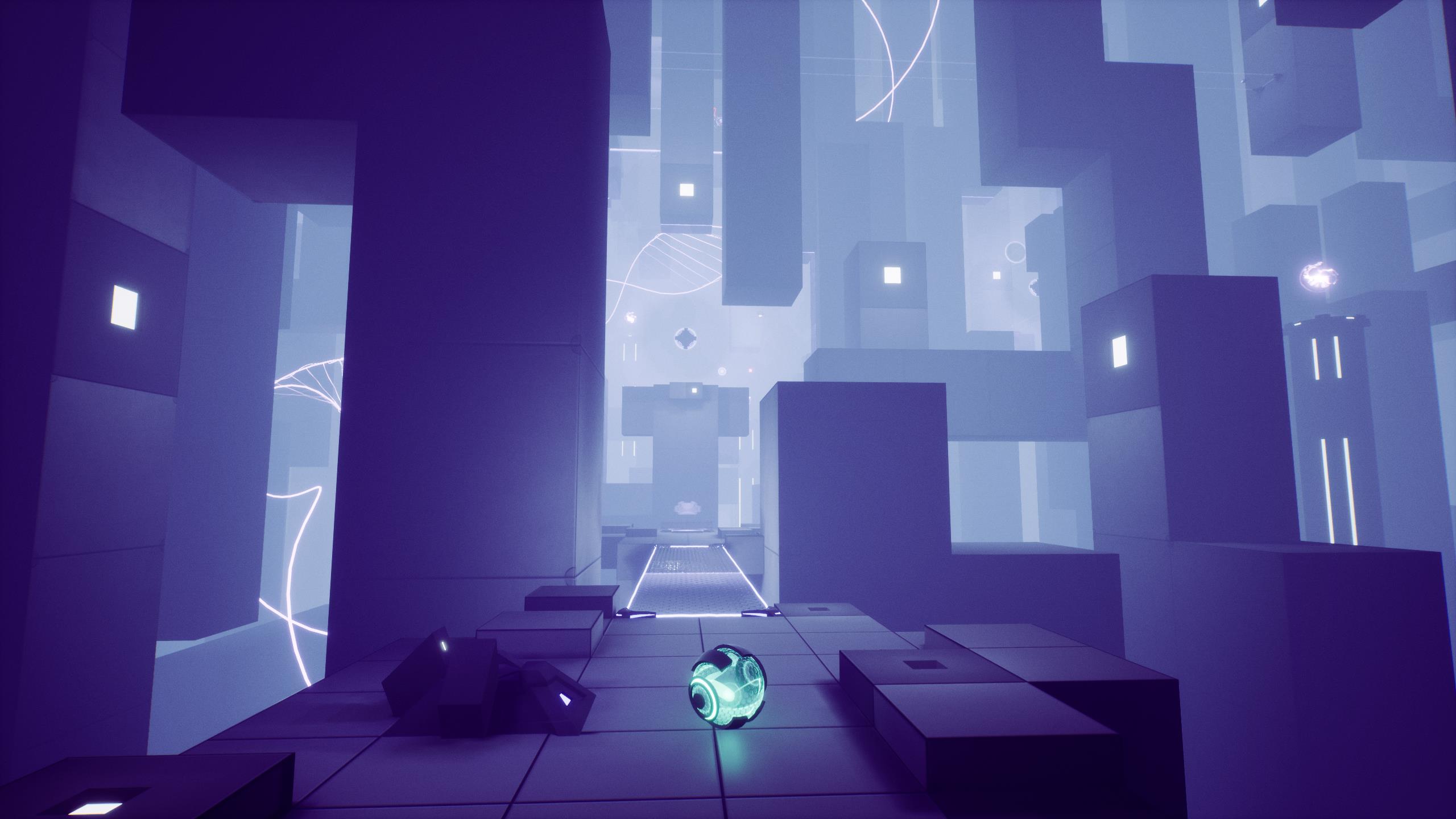
You're a marble, solving marble-rolling puzzles in a neon-lit megastructure. (Took me a minute to catch it was the "Orb Abyss.")
I have loved marble-rolling puzzles since Oxyd. I don't need to remind you how I feel about Tron. So, really, my thumbs-up is overdetermined.
Orbyss starts out with good ol' gates and pressure plates, except that instead of good ol' crates, it's marbles. (Just like you, except obedient.) The game then introduces time-freezing (for all marbles but you), as well as some audio puzzles which would be annoying if not for the "show visual cues" preference.
(I strongly recommend that preference. I enjoy audio puzzles! But trying to keep track of five different beebly noises on top of a maze of switch-gates melted down my situational awareness. If the authors think that's a fun challenge, I want to meet them. Don't worry though; the visual cues snapped it all into place, without spoiling the fun.)
The later levels shift into the kind of puzzle where you have to coordinate with your former self. Or selves. (Marbles.) This is not, to be honest, my favorite kind of puzzle. I can do it; I finished both Talos Principles. I just find it somewhat exhausting. I don't bother unless I'm enjoying the rest of the game.
Which I was! Orbyss is beautiful. It feels great to play. No dexterity-rolling. The programmed-path puzzles are timed puzzles by definition, but the timing is generous and I never got too frustrated. The audio design is sample-perfect. (That's pixel-perfect for your ears.) And did I mention it's beautiful? Chasms of light, planes of force, little green marbles puttering around.
Everybody steals Tron's neon pinstriping. It's the subtle backlit shine of the surfaces that's hard. Orbyss nails it.
The game has a quiet agenda of cooperation, which I appreciated. When you're working with other marbles, or your past self (marble), that's a puzzle mechanic -- but Orbyss makes it thematic as well. You can often spot puzzle maps off in the distance that you never reach. There's other marbles beavering away at them! They commute past you in their little flying saucers! Occasionally you open up a gate for a sibling-marble, or one of them opens up a gate for you. Not in the usual puzzle way; just a favor from a colleague. The final "boss" level is even more down this road.
This is good. These are the days to keep collective action in view. Yes, even in our single-player puzzle games. If Talos 2 and Psychonauts 2 can do it, so can you. I'm happy to see that Orbyss joins in.
Anyway, great game, great puzzles. Go for it.
Footnote on game soundtracks
I'll buy any game soundtrack that I enjoy, but particularly the techno/vapor-wave-y ones. Cloudpunk, SOLAS 128, Entropy Centre, Solar Ash, Rez -- of course Rez. And more. I've been coding to this background music for decades.
The Orbyss soundtrack... I bought it, and then I didn't get into it. Which is weird! I said the audio environment was perfect, right? All the little electronic noises as you move around and trigger things are awesome. The audio puzzle markers are hard to keep track of but they sound great. The menu UI noises made me smile in gentle bliss.
But this doesn't add up to a soundtrack. When I put the Orbyss OST on in my office, it drops out of my awareness. Then it ends and I say "Whoops, it's quiet in here."
Right now I've got the Cocoon soundtrack up. Cocoon is a marble-rolling puzzle game with a Tron-ish vibe, superficially similar to Orbyss. The soundtrack is great; exactly the right balance of present and not distracting. I have no idea how to explain the difference, though.
Funny story: A couple of years ago, I walked past Cocoon at the GDC IGF pavilion. Someone was standing next to the machine. I thought, "Oh, the developer, I should tell him I liked it." Then I saw it was Jakob Schmid, the music composer. I was even more excited! Surely he wasn't expecting anybody to recognize his name and compliment him specifically on his soundtrack work. So I went up to him and did that.
He asked, "What did you like about it?"
I was completely flummoxed. I mumbled something about "good work music" and slithered away.
I hope Schmid wasn't disappointed at my lack of vocabulary. I guess now I could say "Unlike the Orbyss soundtrack, it doesn't disappear from my attention when I play it!" But that wouldn't be very satisfying either.
I apologize to Pierre Estève, the Orbyss composer and sound designer, for this footnote. It works great in the game! I'm just talking about the album presentation.
Estève has a long and illustrious career in gaming, going back to the Atlantis adventure games in the 90s. I had no idea until I looked him up.
Oh, gods, I went and checked my Atlantis 2 review. Twenty-five years ago, I wrote:
Even the music managed to impress me a couple of times, and soundtracks rarely attract my attention.
What a cad. I really am embarrassed now. Time to buy the Atlantis soundtracks off Bandcamp and give them another listen.