

The Fool and his Money returns
Sunday, July 19, 2026 (updated 1 day later)
Comments: 31 (latest August 19)
Tagged: the fool and his money, cliff johnson, astana, quantum noesis, shockwave
Here's an interesting bit of game-historic preservation: someone has posted a browser-playable version of Cliff Johnson's epic (and epically-slow-to-release) 2012 puzzle game, The Fool and his Money. Here's the new web site: www.the-fool-and-his-money.com.
I dunno who did this. Cliff Johnson's original web site, www.thefoolandhismoney.com, stopped working a couple of years ago. I have no leads on what happpened to the man himself. I hope he's okay.
That's the announcement. I'm about to go into one of my rambles through game history, but I figured you'd want the hot link up front.
So, rambling. Way back in my college years, I played a Mac game called The Fool's Errand. It was awesome. Changed my life. (As you know if you played System's Twilight.)
Long after that -- but still a long time ago -- Cliff Johnson announced the sequel, to be titled The Fool and his Money. I immediately pre-ordered it. That was December 2002. After Shade but before The Dreamhold, as S. Morgenstern might have put it.
The game went through, let's say, a few delays. (And I gave it some guff on my blog for that.) But it shipped in 2012 and it was pretty darn good. I said that on my blog. My blog review is cited on Wikipedia, which I guess tells you how big a splash the game didn't make.
Sadly, playing The Fool and his Money has become its own sort of puzzle. The original Fool's Errand was a Mac puzzle game, which means it was released as Mac floppy disks. The Internet Archive is great at Mac floppy disks. You can play it right now! (Also play 3 in Three!)
The Fool and his Money, in contrast, was written in Adobe Director / Shockwave. (A different tech than Flash, despite Flash's "SWF" file suffix.) The "modern" Mac and Windows binaries were essentially launchers for an embedded Shockwave player and DCR media file.
This did not turn out to be a long-term solution. Director was end-of-lifed in 2013; Shockwave didn't last a lot longer. Mac dropped the hammer on Intel 32-bit apps in 2019, and started the switch to ARM in 2020. So running the Mac app at all became a problem.
I don't know what the story was on the Windows side -- better than Apple, to be sure. But even if you could run the app, you couldn't buy it any more. Cliff Johnson used some kind of hand-rolled license key framework. You buy the game, Johnson emails you a license key file.
I can't laugh at this, because it's exactly how I handled System's Twilight registrations for the first couple of years. In fact I would mail back a printed code sheet. I still have a big manila envelope full of registration forms.
But that was 1994. October of 2012 was into the era of Steam Greenlight, if barely; Itch.IO launched six months later. Either would have accepted gamerbucks and handed out The Fool and his Money forever. Cliff Johnson did not choose to avail himself of these services. Instead, he kept hand-crafting license key files... until he got tired of it, or Director broke, or the app ran into compatibility issues, or something. I don't know what straw broke the Tower's back, but you couldn't buy it any more.
A 2023 post by Renzo Pigliacampo cites this response to an inquiry (from TangoBunny, see comment below):
From: cliff@thefoolandhismoney.com Alas, the boat has sailed, hit an iceberg, and sunk. Unlike the 1987 The Fool's Errand, which is still operational, the 2012 sequel is not. Irony, my old friend, we meet again. Cliff
A few months after that, the game's web site (and Johnson's) turned into a fly-buzz banner:

www.thefoolandhismoney.com snapshot circa November 2023
It didn't. The site disappeared entirely in late 2024.
The good news, or interesting news anyhow, is that Renzo Pigliacampo dug into that license key framework. His post describes the process of installing Adobe Director, opening up the game file, and porting the script that handles license keys.
You can access to the encoder, decoder and keygen on GitHub together with the cast decompilation, or online from the extras section here.
We are not done yet, as there's a little detail we overlooked. Back over the game's website, in the installation instructions there are two sections: current orders and true believer pre-orders. The only difference is that the latter doesn't come with a
PassKey.txtfile, only thePassWord. So this means that there has to be a way to enter the game with just a password...-- "Making a keygen for a commercial Shockwave game", 5 May 2023
In other words, the pre-order keylist was hard-coded into the app. And indeed Pigliacampo dug it out! Take a look.
There's me at #10. I recognize quite a few other names on the list, from my on-line and in-person social circles. Also some more famous puzzle fans. Check out #297.
(Special shout-out for Christina Schulman, #134, a friend from Pittsburgh. Christina was the very first person to register System's Twilight in 1994. She passed away a year ago.)
And that brings us around to where we started: the web port of The Fool and his Money.
In the year 2026, I still aspire to finish this damn game, so I ended up porting the original Adobe Director game content to the web.
I’ve made every effort to contact Cliff about this project, but I haven’t been able to reach him. If you know how to reach Cliff — or ARE Cliff — I’d appreciate hearing from you.
I’m sharing this web port in the spirit of software preservation for a game that is no longer commercially available or runnable on the platform that many purchased it on — but especially in appreciation of Cliff’s puzzling genius.
-- from "About this site",
www.the-fool-and-his-money.com
I don't know who put it up. It wasn't me. The web site is unsigned. It claims to be someone on the True Believers list, so that cuts it down to 1600 names or so.
I can say that I did finish the damn game, back in 2012. It was worth playing. I could probably take another stab at it; it's not like I remember any of the puzzles.
So what happened to Cliff Johnson? I don't know. I don't know anybody who knows.
The last news I heard was 2017, when Johnson designed a puzzle for a book on the architecture of Kazakhstan. I realize how that sentence sounds but it entirely happened. I bought the book but I did not try to solve the puzzle.
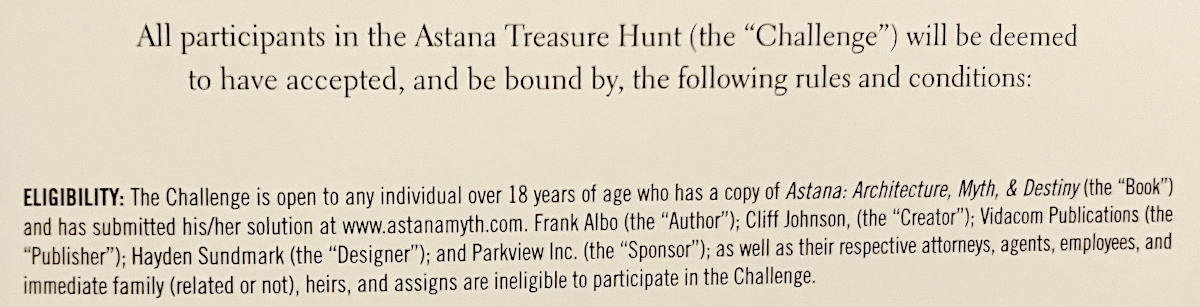 From my copy of Astana: Architecture, Myth, and Destiny, Frank Albo, 2017.
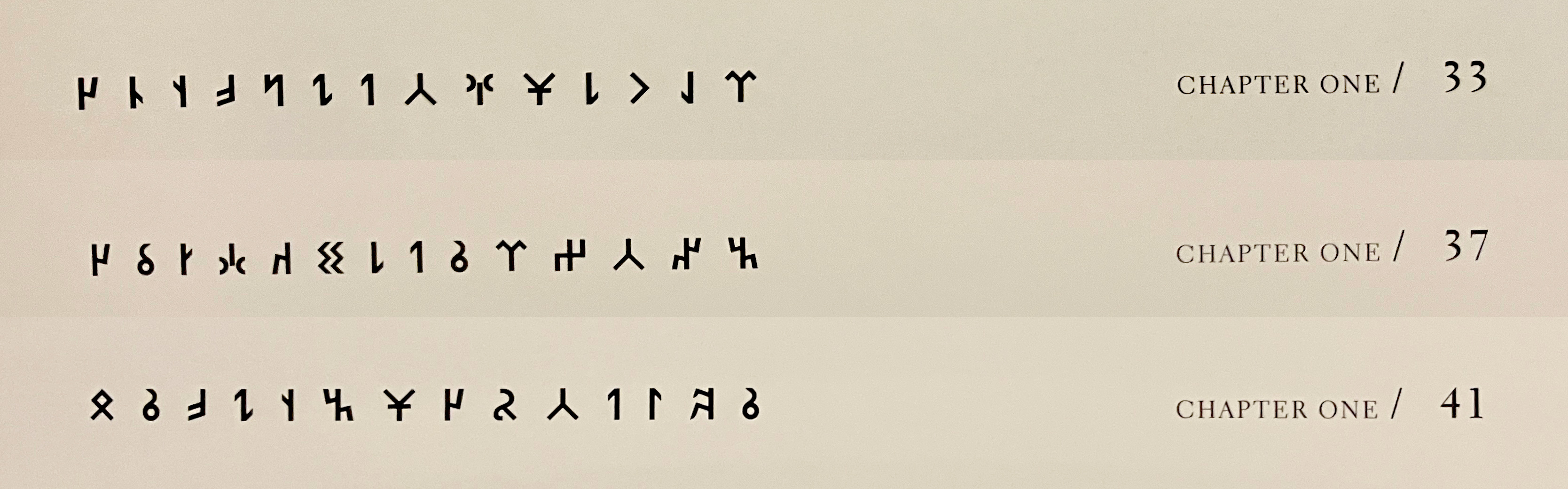 Puzzle-tastic page footers.
I didn't try to read the book, either. It seems to be either pure crackpot woo or a serious monograph aimed at the crackpot woo market. These are the sort of questions which, if the answer were "yes", would not be phrased as questions:
Is Astana the sun-worshipping capital of Zionist Freemasons? Is there an energetic grid linking its major buildings with the pyramids of Egypt? Is the city’s Master Plan a coded magical talisman devised by the New World Order? Separate fact from fiction and find out how an underground stream of design principles and ideas permeates the layout and construction of the most extraordinary city ever conceived.
-- from the Astana web site
Great photos, though.
The book's puzzle page is still up. The original "Closing Date" was supposed to be the end of 2018. I guess nobody solved it, because on the web page, that's extended to May of 2020. There's no indication of any sort of conclusion since then. The people running the contest might have been a wee bit distracted by the end of the world.
Only that's not the last footprint left by Mr Johnson upon the puzzle world. Check out this article from the ancient eldritch time of the blockchain:
Looking for a different type of puzzle game? Quantum Noesis is a game that’s part graphic novel, part puzzle game, unlocks episodically over the weeks and features prizes for those who are fast enough to solve them first and – of course – it’s powered by NFTs and has its own unique token economics and behind-the-scenes AI enterprise.
Are the puzzles number puzzles? Word games?
Almost all of them are word-based puzzles and they were designed by legendary puzzle master Cliff Johnson. Cliff comes up with indescribable, category defying word puzzles, the likes of which you’ve never seen.
-- from "Quantum Noesis: Redefining the puzzle game with a little NFT magic", BlockchainGamer.Biz, 20 May 2022
(Credit to zaratustra on the thinky-puzzle-games discord for uncovering this treasure.)
The Quantum Noesis website lasted a bare two years, from a coming soon page in January 2022 to this snapshot in October 2023. There's some nice art in the middle. The aesthetic is sort of Tron crossed with Poser models, which, okay, I might have gone for that. Except for the NFT stuff. And except for the story, which is exactly the sort of weak-tea five-years-ago "decentralized AI utopia" hype which got stomped flat and incinerated by the corporate dystopian AI of the current hype cycle.
But, indeed, Cliff Johnson is listed as the game's Puzzle Designer. This interview remains live:
Cliff has come on board with Synesis One as our puzzle designer, after connecting with Tracy Spaight. He was drawn to the opportunity to create new conundrums and puzzles against the background of AI singularity and NFT word tokens.
-- from "Meet Cliff Johnson, Puzzle Game Designer", Medium, 23 March 2022
The article mostly just reiterates Johnson's history for folks too young to have experienced it first-hand. His comments about the Quantum Noesis game feel pro-forma. Well, I don't want to project my assumptions. Paying work is paying work.
I guess we can compare Cliff Johnson with Chris Manson, another cult puzzle-master of that era. (Maze and The Fool's Errand were just two years apart!) Manson did another couple of puzzle books after Maze; I spent a summer banging my head against The Practical Alchemist. But then he disappeared from puzzle-dom, preferring to work on illustrated storybooks... until Tonda Ros showed up with Blue Prince and asked him to guest-star.
The difference is that Blue Prince is a genre-defining triumphant hit. The Astana book and David Blaine's Mysterious Stranger were, um, not. I don't think that's Cliff Johnson's fault. Then again, I don't think the success of Blue Prince can be laid at Chris Manson's feet either. I don't know where I'm going with this comparison, sorry. "Riding coattails is a crapshoot"; well, working on your own stuff is a crapshoot too.
Of course the remixes and inspirations echo on forever, but that may be tepid comfort to the original artist.
Let's try a different comparison. People preserve, remake, and reinvent old games. Sometimes it's the original creators taking another run at their old work. Sometimes it's licensed and aligned with the corporate legal framework. And sometimes, as with the Johnson's games, it's samizdat. Under the covers. Puzzle sickos in trenchcoats handing out floppies. That last one was metaphorical.
As you know, I'm going that unaligned route with the Infocom canon. It started out as a community project, which is to say, I ignored copyright entirely. ("Fair use" is something we say to each other, not a legal ruling.) It became Officially Permitted when Microsoft open-sourced the Zork trilogy, but I'm way past that now, back into the technically-illegal.
It's nice when the business world does this work. (You can buy the Zork trilogy on GOG.) It's nice, full credit given, when the business world turns a blind eye to community work. That's the fanfic bargain; unspoken, largely projection on both sides, but real.
But we can't rely on the business world. We can't even rely on the non-profit world. (I say this as the IF Archive lead for IFTF! And a devoted admirer of the VGHF, etc.) The bigger the organization, the more legal crap it has to contend with. That's why my Visible Zorker project isn't an IFTF project; it's me going rogue.
Cliff Johnson, to his credit and his curse, refused to let The Fool and his Money get caught up in the business world. Now just plain folks have to take up where he left off.
If he did leave off. I never rule out a triumphant return, or even a modest low-key return. I'll let you know what I see.
Update with footnotes
Lot of replies to this one! Let me add more info.
First, the original download packages of The Fool and his Money remain available from the Internet Archive. You can download the Windows zip file from that link and play on a modern Windows setup, using one of the passwords in the True Believers list. Feel free to use mine: AND974VPR.
The Mac app is not viable on modern Macs, but can be made to work on sufficiently old Macs. (Looks like it will run on PowerPC or 32-bit Intel Macs.)
If you play on the web, then your progress is saved in local storage (cookies). Beware cookie-clearing.
On the UI
When you launch the game (either on the web or on Windows), you see a screen of twelve Tarot card "tokens". These are your save profiles. The card with the yellow-highlighted name is your current save slot. Since you're almost certainly playing on your own machine, just ignore the token list and hit "Play". You'll be off and running in the default slot.
If you hit "Tokens" you'll be back at the slot-selection screen. Just hit "Play" again.
The "Menus" screen shows all the available levels. Some are unlocked when the game starts; most will need to be unlocked by solving puzzles. There's a "Prologue" which introduces the story, but it doesn't autoplay -- you need to click to watch it.
On bugs
Torbjörn Andersson notes in comments that the Prologue sequence is janky in the web version. Now that I take a look, it's janky for me too.
(The first time I clicked "Prologue", the music played but no further animation started. When I clicked outside the pane and then hit "Prologue" again, the animation started too early.)
The Prologue isn't critical; it just recaps the Finale of The Fool's Errand. But this brings up the possibility of bugs in other scenes or puzzles. I've only tested a few.
Folks also note bugs in the gateway / stained-glass window code.
Comments from Bluesky
Comments from Mastodon
@zarfeblong
And I'm #11 on that list. And still feel entertained that I was immediately after you. (And I too am delighted to see it back online again.)
@zarfeblong Amazing news. I played Fool's Errand back in the day (actually years after it was first released) and was checking Johnson's website regularly for a few years.
@zarfeblong I still have my Windows copy of the game and it seems to still basically work out of the box even on Windows 11.
So the story there with the original code, at least, is much better than the Apple story.
@zarfeblong in a fun coincidence, my reversed Fool's Errand for Macintosh engine landed in ScummVM's nightly build last week.
https://manitu.social/@scummvm/116924018262082053
I did get a message on stream back in February from someone who (purportedly) lived near Cliff, apparently he's still around but moved on from having an online presence.
@moralrecordings Ah, that's good to hear, even indirectly
@zarfeblong Thanks for posting about this! I'm on that list, too, but barely had time to try the game in 2012, and had completely forgotten about it since then.
@zarfeblong It took me a long time to pony up for the pre-order (1479!) because I was SURE that the title was indicating that Cliff had no intention of releasing a game. Eventually, I decided I was okay with just donating that money to him if so, and pre-ordered
@zarfeblong I played through The Fool and His Money again a little over a year ago. The Windows version still works, and is mostly playable on Mac via Crossover. There was an issue around the card games, as I recall, where they wouldn't end properly when you won. I worked around it by copying the save files to an actual Windows machine, winning the card game, and copying them back.
There was also an odd issue where my entering the registration key (#183) wouldn't stick under Crossover, and I had to re-enter it every time I started the game. Once I ran it on Windows and copied the save file back, it stuck.
But a web version is so, so much more convenient.
@zarfeblong I tried reaching out to the NFT game company a few years ago to ask if they still had contact with Cliff, or knew anyone that did. I never heard back from them. I just hope he’s ok, enjoying life somewhere while no longer touching computers
@zarfeblong Oh man, I was that person who enquired about buying the game, and was told the ship had sailed. I’m glad it got preserved in a new way! Certainly beats using other peoples real names or backdoor access names.
@TangoBunny Hey, thanks for the note. Good to have one more detail. :)
Do you remember exactly when you got that reply?
@zarfeblong No idea if images pop up on the blog or just on Mastodon, but this was my entire email exchange. Just that one email from Cliff - May 3rd 2023.
I remember at the time I was trying to access the 'buy' section that the website kept changing sneakily, as if someone was manually changing it when I kept trying to access it.
I don't remember specifics, but it'd change from things like 'Purchases not available at this time' to something like 'The game is no longer available.''
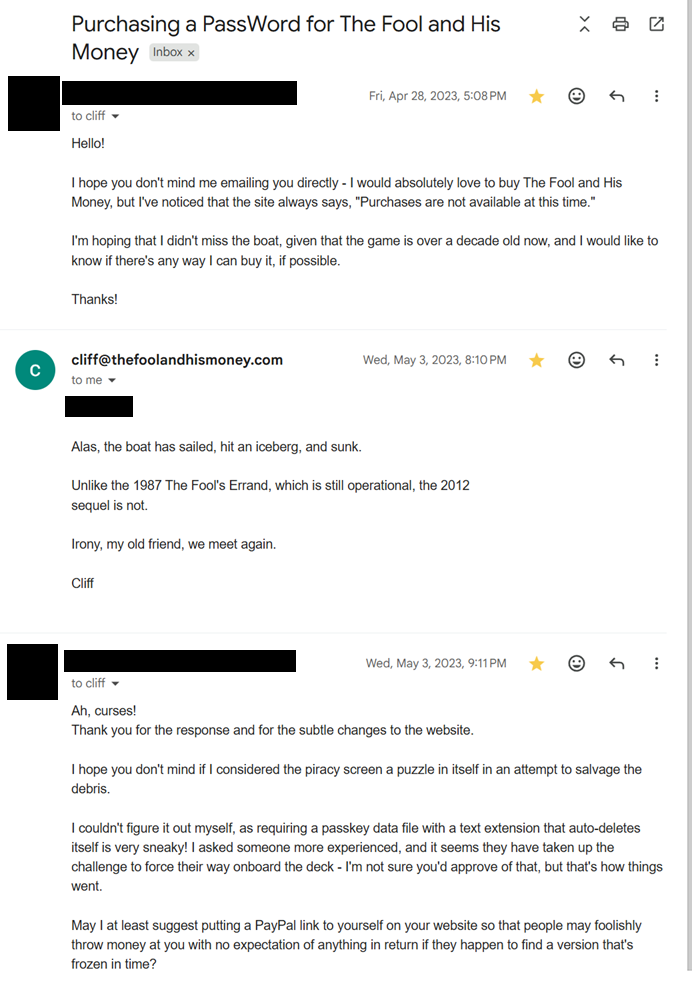
@TangoBunny Excellent, thank you! I will make sure the screenshot saves.
@zarfeblong Greetings from #67! Thanks for passing along this news
@zarfeblong Questions for veterans of the game: How well does this web version work? I know I seemed to have trouble viewing the prologue, at least.
As for the puzzles, I pretty soon realized, that this game is what you get if you take the general structure of The Fool's Errand, ramp up the difficulty, write a new story, ramp up the difficulty, add a bunch of unique new puzzles, ramp up the difficulty...
And then you decide it's still a bit too easy.
@et_andersson The prologue does seem to be somewhat scrambled, now that I try it. (Some of the animation did not happen; when I clicked outside the pane and hit Prologue again, the animation started too early and got mixed up with the intro music.)
I'm playing through, but it'a possible that it's broken at the 'first gateway'? I've finished the seven windows, and get one (a central one) that flashes green. But, when I click through each window, none of the green flashes appear in the flashing stained glass and I get 'undefined' instead of 'first', 'second' etc. Seems wrong?


@jeremygans “Undefined” does seem wrong. I have only played a little bit of the web version though. Sorry...
(I started to replay the Windows version but probably won’t stick with it.)
@zarfeblong Ah well. I bought the original when it came out, but gave up quite quickly, I recall. Enjoying it much more now with some help from walkthroughs...