

Effinger replies to me
Wednesday, June 3, 2026
Comments: 3 (latest 2 days later)
Tagged: infocom, zork, george alec effinger, byron preiss, books, trinity, aeon, rpgs
I posted a couple of weeks ago about Infocom tie-in novels, with a bit of a digression on the work of George Alec Effinger. It turns out that I have a response from Effinger to relay!
Not a response to my 2026 post, obviously. Effinger passed away in 2002. But his books were mentioned on Usenet in 1997. It was a thread about the "Groundhog Day" trope, which brought up Effinger's books The Nick of Time and The Bird of Time. (The first Effinger that I read, as it happens.)
Anyhow, someone made a rather dismissive comment to the effect of "...before Mr. Effinger ran out of ideas and was reduced to writing things like 'The Zork Chronicles'." And guess who showed up to riposte?
Newsgroups: rec.arts.int-fiction Subject: Re: Groundhog Day as Interactive Fiction Date: Tue, 13 May 1997 14:41:42 -0600 From: g.effinger2@genie.com
I've read with a lack of amusement the opinion that I wrote THE ZORK CHRONICLES because I ran out of ideas. Generally, I don't respond to negative opinions of my work--I really don't expect everyone to like everything I write. I don't like everything I write. I'm interested to hear why some of my stories or novels don't work for particular readers; however, "Mr. Effinger ran out of ideas" doesn't convey any useful information to me. [...]
I regret to say that I had also posted to that thread -- agreeing with the original poster. Although, in my defense, I added that I was a Glorian of the Knowledge fan. Still, embarrassing. And not just because I totally forgot that this exchange happened! Thirty years ago. Yikes.
You can read Effinger's entire post here. If Google Search goes ass-up, as it keeps threatening to, you can also find the post archived in this Usenet thread collection (unzip, search the text file raif970828).
However, I need to quote more of Effinger's post. It gives valuable context for those days of 1989 or so. And, well, it trashes a lot of the assumptions I made in my earlier tie-in post. Further embarrassment! At least I tried to label all my assumptions as assumptions.
I wrote that Effinger might have written The Zork Chronicles "as an on-ramp to the videogame industry". Turns out I had it backwards:
I wanted to write the novel and this was an opportunity to do it. Also, I had worked with Infocom when I wrote a game for them, "Circuit's Edge," based on characters and locations in WHEN GRAVITY FAILS, and I liked the Infocom people. They asked if I'd be interested in doing a novelization for them, and they offered me what they called "the big one"--the Zork games. I'd played all the games enthusiastically when I got my first computer, years before, and I was glad they thought of me for the book.
(Effinger, ibid.)
That bit shows up another of my mistakes. I asserted that Effinger was not a gamer or a computer nerd. I was going off this interview, recorded in 2020. There, Mike Legg says that Effinger "...didn’t have a PC, he didn’t have a word processor; at least I don’t think he had." Oops on both of us.
Jumping back, and relevant to the topic of my original post, Byron Preiss:
First, although I've faced large medical debts for a considerable time, I didn't write ZORK for money. I was paid $5,000 for it, a flat fee from the packager, with no royalties--something I tell my writing class not to do (work-for-hire it's called). I did it, knowing I'd never see another penny and knowing that the $5,000 was probably not enough to cover my living expenses during the time it took to write the book, because it was a book I'd always wanted to write. Not THE ZORK CHRONICLES, but the third book about the character of Glorian; he was in WHAT ENTROPY MEANS TO ME and HEROICS, and this was to be his apotheosis. I was discouraged in writing such a book because my Budayeen series looked more promising, and because my earlier humorous books never did well in a commercial sense (BIRD, NICK, and HEROICS have never even been in paperback).
(Effinger, ibid.)
Preiss was referred to as a "book packager" in this 2019 article. It's good to see the use of the term validated.
I do get to correct Mr. Effinger in turn on one trivial point: The Nick of Time and The Bird of Time were published in paperback editions -- in the UK. I only know this because I picked up a second-hand copy. (Possibly at the Toronto Worldcon of 2003.)
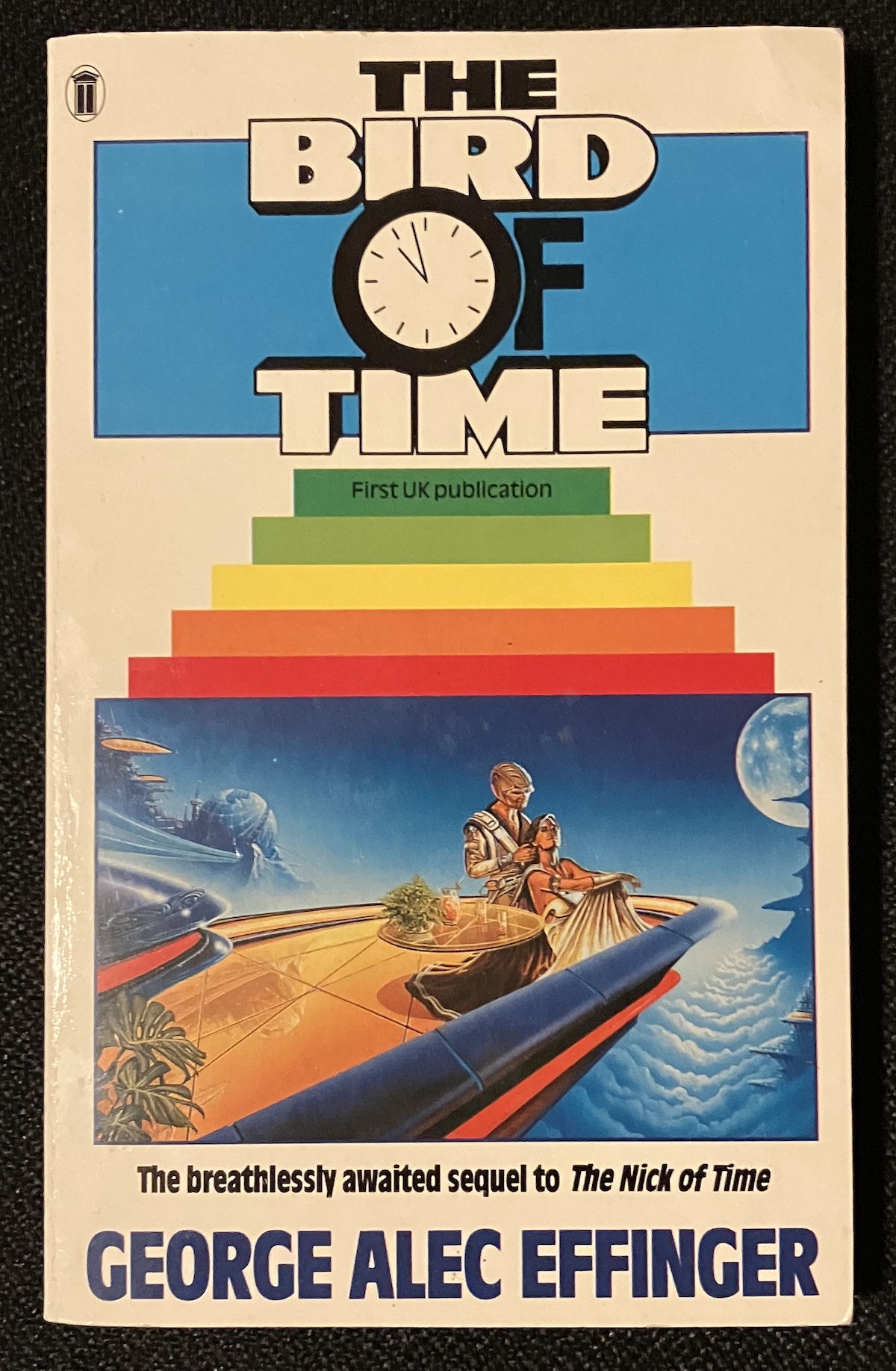
Effinger goes on to defend the practice of writing licensed works, and to deny that they're inherently crap. He is polite but clearly annoyed that he has to do this. I won't quote because we've hopefully grown out of making such attacks.
On to more interesting details:
I am currently engaged in helping to develop a game entitled "Aeon" with White Wolf, and I'll be doing more work-for-hire books for them. A legal situation has prevented me from delivering any new books under my name using previous characters or series--especially finishing the last two books in the WHEN GRAVITY FAILS series. I may never be allowed to publish them, so I've had to turn entirely to work-for-hire until the final judgment is made later this year.
(Effinger, ibid.)
The legal situation is mentioned in Effinger's Wikipedia entry: a medical bankruptcy which could have stripped him of his ownership of his own work. Happily, that didn't happen. He went on to publish those two sequels, A Fire in the Sun (1989) and The Exile Kiss (1991), to acclaim.
But what about that game "Aeon"?
However, although I'm making the same money now that I made for the Zork book (i.e., not very much although White Wolf will pay me royalties), I'm eager about the project. Andrew Bates, the game's developer, has some wonderful SF ideas, and he's been enthusiastic about my thoughts and suggestions. I was approached originally about doing only an 8,000 word short story for the game's original book, but the novels happened only after I decided I liked the intelligence and possibilities of the setting and theme. The novels' story and most of the characters are mine, not White Wolf's, and will be incorporated in the game itself.
(Effinger, ibid.)
 A bold choice of cover design.
ÆON, an ambitious sci-fi RPG, was released by White Wolf Publishing in late 1997. They promptly got slapped with a lawsuit from MTV's animated show Æon Flux. One hasty press release later, the game was retitled Trinity.
RPGs aren't my field, so I won't try to summarize the history of Trinity or Effinger's connection to it. It seems to still be in print (now from Onyx Path). Hopefully Effinger got his promised royalties.
One can peek at the original Æon/Trinity rulebook. (A true monument to the '90s trend of hyper-greeblied page layouts!) The book opens with the promised Effinger short story. It's titled "The Honored Dead"; it's literally the first twenty pages of the rulebook, before the table of contents.
...I just sat down and read it. It's a decent bit of sci-fi thriller. Tough Guy and Mysterious Lady smuggle some valuable biotech across the Alps. Which cup is the Maltese Falcon cryovial under? It's got character backstory and an intro to some big-shots of the Æon setting. (As promised, their names appear in the background material of the rest of the sourcebook.) What it doesn't do is give a sense of the setting as a whole. There's supposed to be aliens, space colonies, a world reshaped by psi-wars. What we see is a few miles of Switzerland. Fine for a story, questionable for an RPG intro.
Also, as I said, I prefer the whimsical Effinger. White Wolf hired the gritty one.
But what about those novels? Sadly, they never appeared. Wikis mention the titles as Æon 1: Dawn and Æon 2: Meridian -- both cancelled in 1998. Effinger says they "happened", which sounds like manuscripts got written. If so, they presumably got stuffed in a drawer and remained there until his death.
Of course, I've gotten myself into trouble with assumptions before...
I should note that the Onyx Path Æon page lists stories titled Dawn and Meridian. However, if you click through, they're shown as novellas (not novels), written in 2021 by Lauren Roy and Chris Allen respectively. Written from scratch from the original 1997 outlines? Or just borrowing the titles? I have no idea.
Well, that's all I've got on this particular path. My very belated thanks to Mr. Effinger for dropping in on our discussion, and my very belated apologies for my mostly-dismissive attitude back then.
Although... Huh. One of the designers of Trinity, after Andrew Bates, is a guy named Richard Dansky.... who's giving a talk at NarraScope in less than two weeks. Maybe I'll corner him and ask him about Effinger.
@zarfeblong I think Bird of Time might have been my first Effinger novel, too! Though I had read some of his short stories before that, in the pages of IASFM (I recall "The Beast From One-Quarter Fathom" and "White Hats," in particular).
But speaking of the time-travel stories: I thought about Effinger today when my wife and I split a pack of Chuckles. 😂
And your last post about Zork Chronicles sent me re-reading it for maybe the 20th time. 😊