

A brief digression into Infocom tie-in novels
Friday, May 22, 2026
Comments: 32 (latest 4 days later)
Tagged: infocom, zork, byron preiss, george alec effinger, arthur byron cover, craig shaw garder, robin wayne bailey, books
Last week someone passed around a link to a post: "Classic Zork Novels, Now in E-book Format!"
That's right, it's another instalment of "Somehow, obscure Zork media returned"!
This time we're stepping out of the digital realm and into the world of official Zork (and Zork adjacent) prose. Presented here are four novels:
- The Lost City of Zork by Robin W Bailey
- The Zork Chronicles by George Alec Effinger
- Enchanter by Robin W Bailey
- Wishbringer by Craig Shaw Gardner
Thanks to the work of dedicated fans, these books have been available as scanned pages for many years in places like The Internet Archive. But with advances in OCR tools, it was now possible for me to convert these pages back into editable text with no compromise to accuracy.
-- PaulloDEC, May 13th
See the post for download links. PaulloDEC has now followed up with downloads of the four Zork-themed gamebooks.
So, this is convenient. These aren't rare books. As the post says, you can easily find scans of them (e.g. here). The used paperbacks are also not too hard to track down. I have Wishbringer and The Zork Chronicles on my shelves. But .epub files are easier to tote around.
The post got me looking at the books again, though. They're rather puzzling artifacts.
The gamebooks aren't that surprising. They were written in 1983, a time when Infocom games were really popular, and Choose-Your-Own-Adventure-TM books were really popular, so why not do some knock-offs and see if they sell? (I have no idea if they sold.) They were written in-house by Steve Meretzky and published by Tor Books.
Digression from the digression: Tor was a young company (the same age as Infocom!), but it had launched with star power in both its editorial staff and its initial author lineup. Just to name a couple, they had Gene Wolfe, Orson Scott Card, and a promising newcomer who went by Robert Jordan. It seems they were happy to take on some smaller fry as well.
Again, I don't know what the sales figures looked like, but Infocom didn't follow up with any more gamebooks after the four Zork titles. So it's a fair guess that sales were tepid.
The books themselves are, let's say, workmanlike. Or maybe the later ones are really good! No, probably not. I confess that I've barely flipped through them.
Even more disgression: The first gamebook mentions the "Three Palantirs of Zork". (The three crystal spheres in Zork 2 are referred to as "palantirs" in the source code, but the game never says the word out loud.) This mostly indicates that the books weren't notable enough for the Tolkien estate to sue over.
The novels, on the other hand, are way more interesting.
Timing, for a start. Here's the full list:
- Planetfall, Arthur Byron Cover, 1988
- Wishbringer, Craig Shaw Gardner, 1988
- Enchanter, Robin Wayne Bailey, 1989 (no scan online)
- Stationfall, Arthur Byron Cover, 1989
- The Zork Chronicles, George Alec Effinger, 1990
- The Lost City of Zork, Robin Wayne Bailey, 1991
As you see, the two Zork tie-in books shipped after Infocom had dissolved entirely -- and well before Activision brought the brand back with Return to Zork. Curious!
The novelization project must have kicked off in 1986 or 1987. At that point, Infocom was in financial straits and had been acquired by Activision. It seems certain that the books were a flailing attempt to find more revenue somewhere. But unlike with the gamebooks, the original Infocom crew doesn't seem to have been involved at all. Other than a 1988 press release in the Status Line newsletter, I can't find any discussion of the novels in Infocom memos or internal discussion. (If you find something in the Cabinet that I missed, let me know!)
My assumption is that Activision set up a deal for six books in three years (or two a year with options to continue), and that's how long it ran. The shutdown of the Infocom office wouldn't have factored in.
As to the authors... the Status Line article says "new novels by leading authors", which is a stretch. Craig Shaw Gardner and Robin Wayne Bailey were newcomers with a couple of readable but not groundbreaking fantasy novels each. Arthur Byron Cover had a few more years of publication history but was definitely not a big name. On the other hand, all three had done tie-in or shared-world work; they were clearly happy to crank out words to spec in somebody else's playground.
Oh, but then there was George Alec Effinger, the genuine star of the list. His debut novel What Entropy Means to Me (1972) had earned a Nebula nomination out of the gate. The following years had produced a string of offbeat, absurdist stories in a deadpan style which drew critical if not mainstream attention. I discovered Effinger in high school with Heroics, in which a senior citizen is assigned a professional supernatural guide and dragged across post-civilizational America to complete her collection of twentieth-century Depression glass. The Great Plains have been Teflon-coated. ("So that nothing would stick to them.") Shoulda been as famous as Hitchhiker's, as far as I was concerned.
Effinger had just landed his mainstream breakout with When Gravity Fails (1987), a thriller about a brain-hacked gumshoe named Marîd Audran. It was cyberpunk with a North-African, Arab-Futurist tilt; it made a splash. Effinger was busy turning that hit into a trilogy. Why would he step off the escalator of success to do a videogame tie-in?
As an on-ramp to the videogame industry, perhaps. The Zork Chronicles is dedicated (in part):
To Rob Sears of Infocom, and Brett Sperry, Mike Legg, and the rest of the gang at Westwood Associates, who have made my own Infocom game, Circuit’s Edge, a reality.
Again, a bit of a stretch. "Infocom" by that point was a brand name in Activision's portfolio. Circuit's Edge wasn't a text adventure at all. It was a graphical RPG, set in the same Marîd Audran continuity as the cyberpunk trilogy. This interview notes that Effinger was deeply involved in the design and writing, despite not being a gamer or a computer nerd (at least not at that point).
I'm afraid I never played Circuit's Edge. I preferred Effinger's older stuff to the brutal and cynical Audran books, and the idea of a combat-heavy RPG didn't really appeal. Nonetheless, I was glad to see that the game existed and the author was making some money off of it.
But back to The Zork Chronicles. I wouldn't be at all surprised if Effinger took on the project for the sheer fun of it. It was an opportunity to go back to his absurdist roots. Mirakles of the Elastic Tendon (the Adventurer's most barbarian-esque iteration) meets up with Glorian of the Knowledge, the shape-changing supernatural guide from Heroics and What Entropy Means to Me. In fact the whole project is less a Zork novel than a few Zork characters and familiar scenery transplanted into Effinger's peculiar and whimsical world.
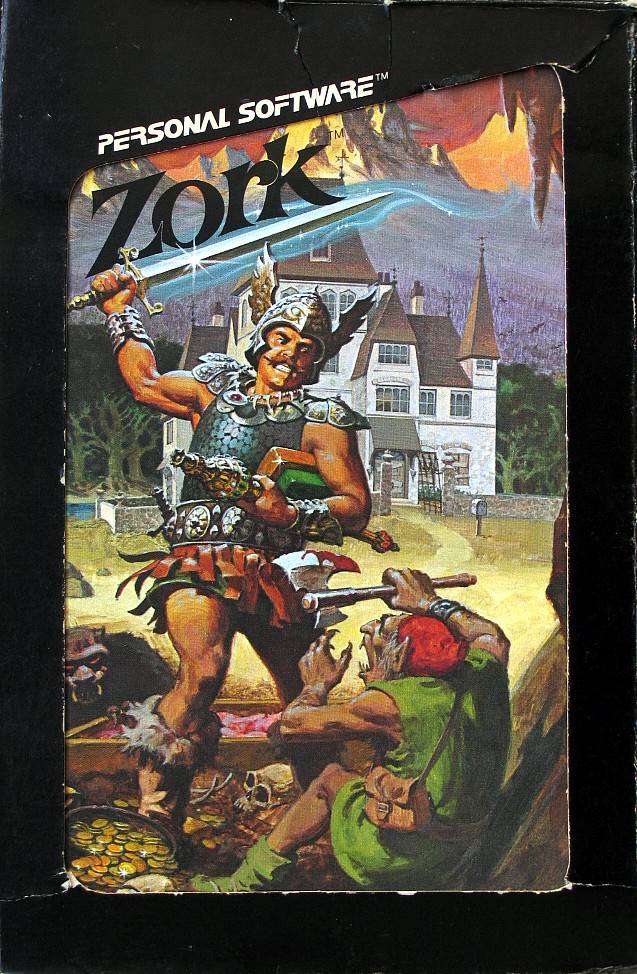
Also there's a great quantity of very bad computer puns. (The Dipped Switch, the Scroll Lock, and alas more.) If Effinger came up with those, it's because he read a lot of microcomputer manuals in a hurry and then decided to share the pain.
After all that, what really confused me was the title page.
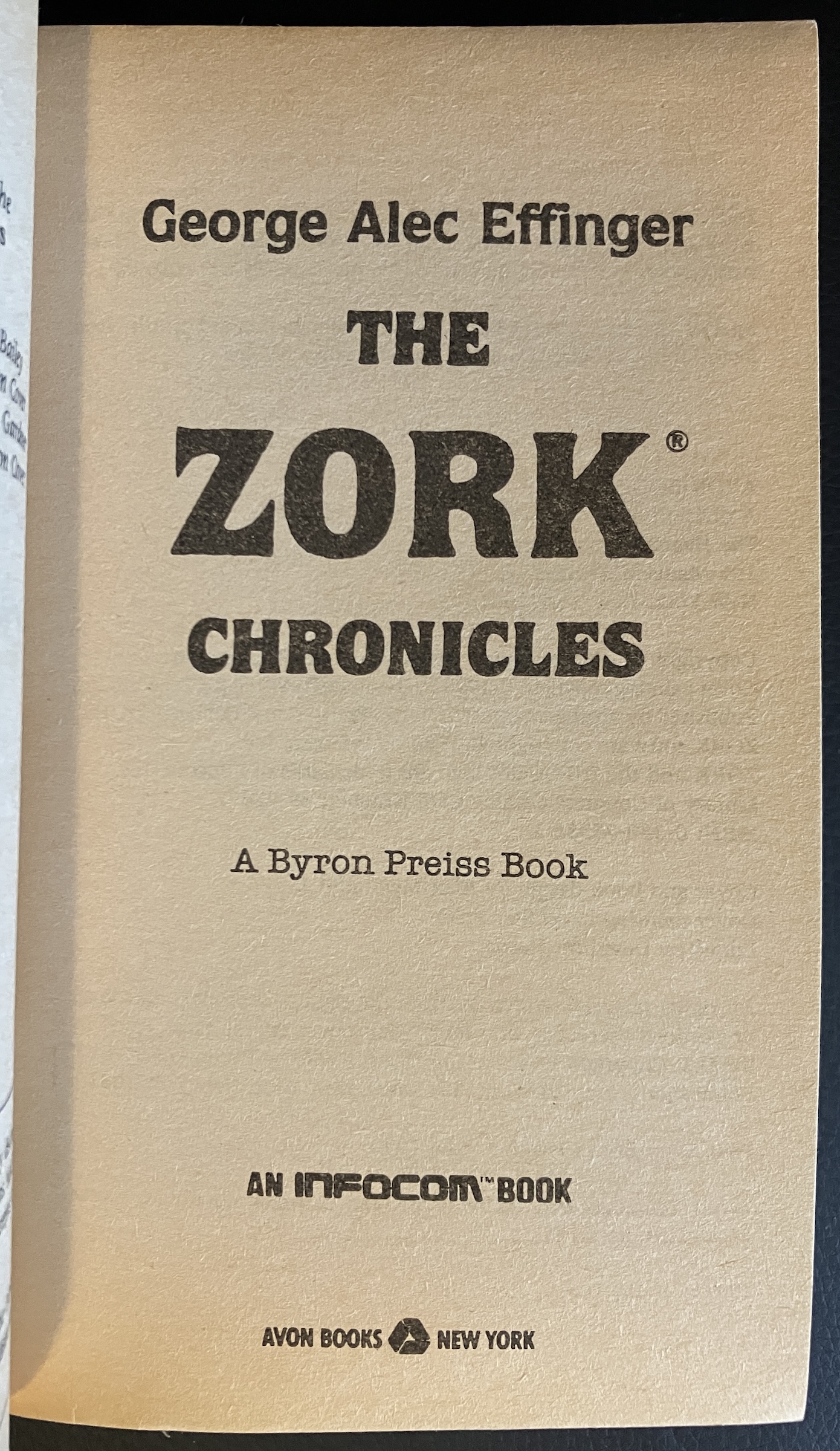 The title page of The Zork Chronicles.
I set off on this road trip with one question: who owns the rights to these books? (I hope you're not disappointed at finding such a pedantic issue at the end of all these circuitous, or circuits'-edge-ous, digressions!) But that page doesn't really clear anything up, does it? This Effinger book is an Infocom book and a Byron Preiss book and it's from Avon Books.
Better check the copyright page:
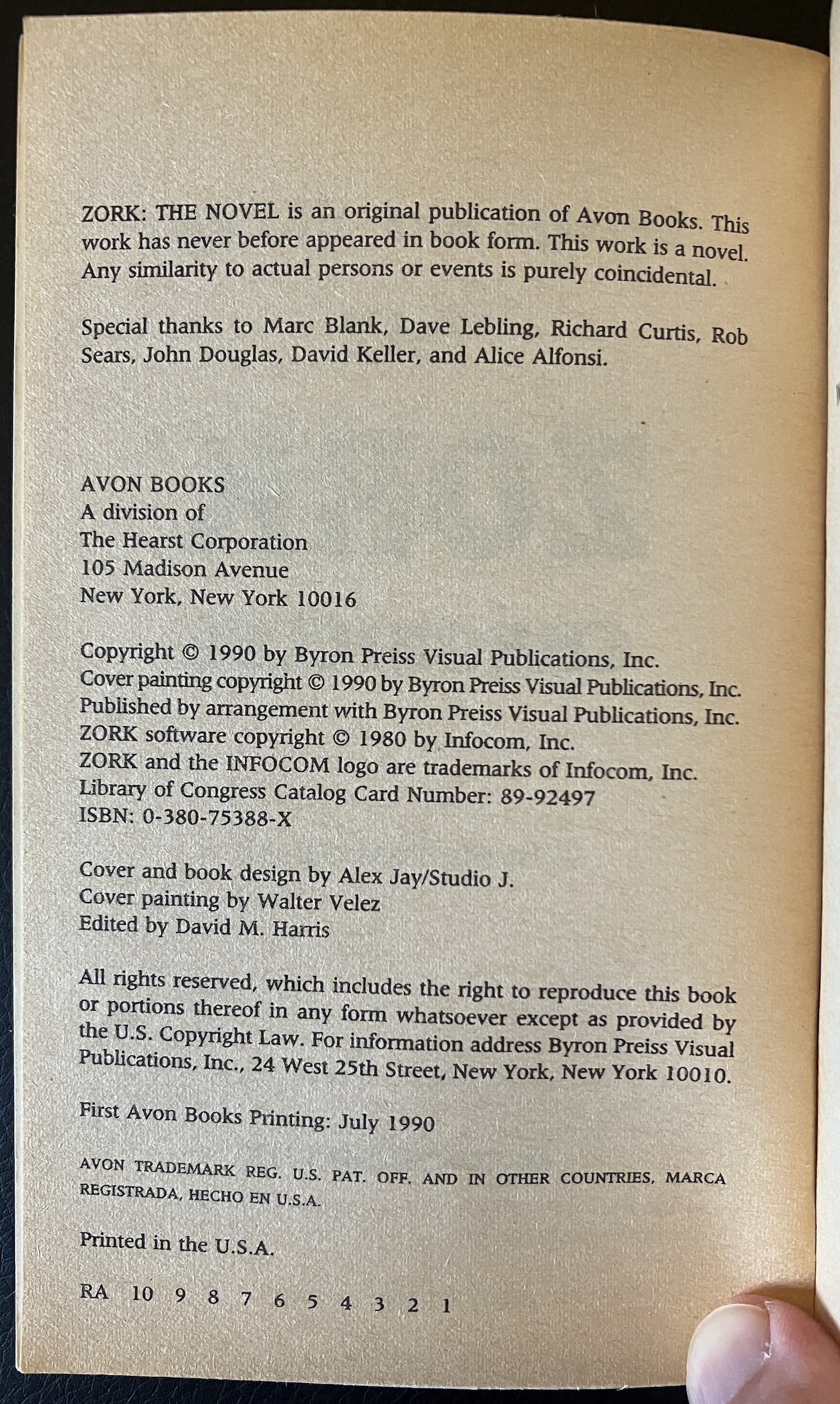 The copyright page of The Zork Chronicles, and also my thumb.
That's straightforward: the novel's copyright is owned by Byron Preiss Visual Publications.
Why, though? For a tie-in novel, you'd generally expect the rights to be owned by the company that licensed the work. Those Zork gamebooks from 1984 all say "Copyright Infocom, Inc." Star Trek novels of the era say "Copyright Paramount Pictures". The X-COM novel I've got (don't laugh, it's Diane Duane) says "Copyright MicroProse". And so on. It's work for hire, and the company does the hiring. Only not in this case.
At first glance, I thought Byron Preiss Visual Publications was the publisher. But that's clearly wrong. The publisher is Avon Books, an old-school publisher of genre paperbacks. Mostly romance (that's where the money was and still is) but back then Avon had a well-established sideline in sci-fi and fantasy. They were clearly in charge of the book's layout; they reserved the back flyleaf as an ad for Avon's then-big series launch, Roger Zelazny's Second Amber Chronicles.
(To be sure, the back flyleaf of the Wishbringer novel is an ad for Planetfall.)
So if Byron Preiss was not the author, licensor, or publisher, what was his role? The best explanation I've found is from an article "The Strange Case of Byron Preiss Visual Publications" (PG Williams, Journal of American Studies, 2019). (The magic citation thingie says "2021", I don't know why.)
The article is primarily about Preiss's adventures in the comics industry in the late 1970s. It doesn't mention Infocom or gaming at all. However, it begins:
Between 1976 and 1979 Byron Preiss operated as a book packager specializing in graphic novels, bringing comics creators together on original stories and licensed properties and delivering the finished product to publishing houses.
Further explanation from the article:
These agents, known as “book packagers,” would generate ideas for authors and bring writers, studios, and fashionable subjects into conversation. Packagers could have a book’s licensing rights finalized before the first draft was finished – in some cases, before writing had begun.
[...] BPVP brought comics creators together to deliver books to publishing houses as finished packages. Preiss sometimes wrote these books himself, or he paired up writers and artists, or he bought the rights to creative properties that other creators developed under his editorial control. Preiss operated as a book packager and not a self-publisher on the basis that if you only published a few books at a time, the resources invested were not likely to recoup adequate profit; he pursued multiple projects simultaneously...
In other words, Preiss ran a sort of middleman empire, setting up a whirlwind of deals -- and somehow having all the rights land in his pocket. It seems sketchy to me, but hey, I wasn't in the business. And he did get a lot of books published.
The article focuses on Preiss's ambition to legitimize "graphic novels", and the reaction of comics fandom to this new and opinionated player. Preiss apparently annoyed a lot of people.
It's also worth noting that the Infocom deal wasn't Preiss's first contact with the game industry. Under the label Byron Preiss Video Productions, he worked with Trillium/Telarium and Windham Classics to produce adventure-game adaptions of four books.
To digress even further (hey, this is the fun stuff): Preiss had attempted to get in on the Masquerade treasure-hunt craze. The Secret (1982) presented itself as an illustrated encyclopedia of modern Faerie. (The artists included then-newcomer John Jude Palencar, now a big-name SF illustrator.) The book was supposed to clue the location of twelve treasure-boxes around the US. Apparently only three have been found -- one as recently as 2019.
Whew! Okay, back to the question.
So where are they now?
George Alec Effinger suffered life-long health problems. He died in 2002 in his beloved home town of New Orleans. (The Budayeen, Marîd Audran's home turf, apparently draws as much from the French Quarter as from the Middle East.)
The other three authors of the Infocom novels are still around, as far as I know. So is Steve Meretzky. Apparently Meretzky was even at GDC 2026, although I didn't catch him there.
Byron Preiss was killed in a car accident in Long Island in 2005. His multifarious publication businesses were all apparently a one-man show; they did not survive his death. His widow announced in 2006 that BPVP was filing for Chapter 7 bankruptcy. The company assets would be sold to pay off creditors.
So who got them? I expected this to require a tedious legal trawl, but in fact the answer turned up on the first web search. (The open web: not yet entirely destroyed!)
J. Boylston, Publishers, announces the acquisition of the companies owned by the late Byron Preiss. Ibooks, the trade publishing house known for its extensive backlist titles in science fiction, fantasy, history, popular culture, and military nonfiction will continue its publishing program of bringing new and solid titles to the marketplace. Readers of notable authors as Isaac Asimov, Roger Zelazny, Stan Lee, John Betancourt, and Chris Beakey will enjoy new and familiar favorites as the company develops its rich backlist while presenting a new generation of writers to booksellers.
-- Press release, December 2006, via ComicsBeat
The ComicsBeat article notes that the sale price was $125,000, which "seems low given the number of contracts Preiss had – numbering in the thousands." Here's another article saying the same. However, it's likely that most of those contracts had expired or reverted.
I should explain that the typical book contract has a reversion clause. If the publisher allows the book to go out of print, they lose the publication rights. The author (or copyright holder) is then free to seek out another publisher or self-publish the book.
Preiss must have had some good sellers, on the sheer numbers. But I can't imagine that the Infocom titles were high on the list. They must have gone out of print (with Avon) almost immediately. And then they sat in Preiss's closet, unused. I don't know if Preiss's deals with the authors were still in force, but it's a moot point if the books weren't being sold.
J. Boylston & Co still exists. They've got a web site up as ibooksinc.com. ("IBooks", with varying capitalization, was another brand that Boylston picked up from the Preiss estate.) The site even still lists Byron Preiss Visual Publications as an imprint. The titles number in the hundreds, though, not thousands. And the Preiss portfolio is rather scattered, with only a few listed directly under "BPVP".
Alfred Bester, Roger Zelazny, Isaac Asimov, and Tanith Lee are proudly featured on the site. As is The Secret, the treasure-hunt extravaganza. Arthur Byron Cover, Craig Shaw Gardner, Robin Wayne Bailey, and George Alec Effinger are not to be found.
No, wait, a Bailey fantasy trilogy called "Dragonkin" is listed. Go him.
So that's where we stand. A brief experiment in IF novelization, abandoned and left to evaporate in the sun. Feel free to download the books off the links above; nobody's watching.
I doubt anybody is all that excited to read them. I plowed through Wishbringer this week. Skimmed through it, I should say, with grim tenacity. The writing wasn't bad, but it was, well, cutesy. The game characters and scenery were, honestly, well done. Gardner clearly thought about them and came up with his own takes, neither slavish nor unrecognizable. Still, a slog.
Even The Zork Chronicles -- for all my admiring comments about Effinger's writing -- defeats me. I've read it in bits but never all the way through. Effinger can do cutesy and make me like it. But he can't make the Topiary Garden (Zork 2) or the Scenic Vista (Zork 3) more interesting than they were the first time. And the puns, yeesh.
"Above The Powers That Be is the Autoexec," explained Glorian. "Above the Autoexec is the Control Character. No one I ever know has ever seen the Control Character. A lot of us Association members even think he's a myth. I mean, a non-existent myth, not like the real myths the rest of us are."
See? Simultaneously adorable and grating. And that's if you're into Effinger's stuff. He's at his best when he can spin off into unexpected tangent after unexpected tangent. The prescriptive rote of Zork IP just weighs him down.
Still, it's a part of Infocom history.
Hey, the ibooks site lists a contact address for "Media rights inquiries". Should I... hmmm... maybe I will.
More news if I get a reply.
Comments from Andrew Plotkin
Publisher replies!
Thank you, Andrew.
We’ll schedule these for release at some point in the near future.
Commissioned by Byron Preiss, the works were part of a cross-over plan where Byron developed literary properties to computer games. And in some cases, games to literary properties. The theme was to engage the reader through visual application. He published some of the first graphic novels in the 1970s writing several himself. Byron tragically died before the proliferation of online access. He was ahead of his time.
So there we are.
Comments from Bluesky
Comments from Mastodon
My reaction to that last bit:
This way lies madness.
@zarfeblong Thank you for sharing these. I had only read the first Zork gamebook before. One very mildly interesting fact is that Zork Nemesis references them. I've always been curios about the other Infocom related books
@MichaelKlamerus Good grief, I don't think I noticed that. Not that I remember the Nemesis setup well at all.
(Mostly that all the references felt forced.)
@zarfeblong One minor point, which I suspect is just a mix-up due to GAE having similarly-constructed titles - your line about Glorian being in Heroics and When Gravity Fails: I don't believe Glorian was in WGF, but he's the main dude in What Entropy Means to me. :)
@icecreamjonsey Oh, you're right. Thanks. I mix up the titles for the obvious reason...
(EDIT: FIXED.)
@zarfeblong Thanks for writing all this! It's funny to me to see all the computer puns listed like this. I had almost nobody in my life at that time that I was talking to making any kind of "keyboard jokes" like with the Scroll Lock and such, so I probably forgave a lot. Plus, if my memory is correct, he gives away the solution to the coal mine puzzle. I remember, hopefully accurately, reading that bit and rushing to start Zork to finally finish it after years!
@icecreamjonsey @zarfeblong For me it helps that I'm tech-illiterate to the level that I recognize the computer puns, but beyond that don't _understand_ them enough to find them painful. 😊
@zarfeblong I have three of the game books, which I remember as cute but not particularly memorable. The only one of the novels I've read was Planetfall, and... I remember disliking it, but I couldn't say if it was actually bad or if it just didn't feel anything at all like the game.
I'm pretty sure I donated my copy as a prize for the IF competition back in the nineties.
@et_andersson @zarfeblong I also read Planetfall and remember disliking it, but also for some reason tracking down a copy of Stationfall, which I think I might have liked a little better. I think I still have them. And maybe Wishbringer, but I never read that one.
@zarfeblong FWIW, I re-read The Zork Chronicles every few years; it's one of the only fantasy novels I've ever really enjoyed, and the only one I've ever read more than once apart from the Master Li books.
Which probably says something about something but, best not to know what, perhaps. 😅
@SJohnRoss Oh good! I'm glad somebody appreciates them properly.
I haven't re-read Effinger's original stuff for decades. I should, but I promised myself to re-read the Heaven's Vault books next...
@zarfeblong Interesting! I knew this novels existed, but nothing more. I remember to borrow the gamebooks from the local library in the 90s and asking myself "What is Zork?"
So... thanks! This kind of tie-in book is something i always loved and to know more about the zork ones and the zork-related is something nice ;)
@zarfeblong My very first thought when you explained about the original link was, "but is that legal now?" So I was not disappointed at all when you went on to pursue the copyright situation. Thanks for persisting!
@zarfeblong @rk I had the wishbringer text adventure game. It had some of the best box art/theme and extras. I probably have the glow in the dark rock somewhere
@rtificial @rk I definitely still have the stone. The rest of the package disappeared into a basement and I think got lost in a move. Ah well.
It’s probably in the attic next to the old map of Paris.
@zarfeblong I know I have three of the paperbacks on the shelf next to my boxed Infocom games and Lost Treasures sets, and I think I have four. I remember liking them, but I read them in my teens or so
@zarfeblong Five! And I know I had a copy of Wishbringer at some point...

@zarfeblong Effinger posted to raif: https://groups.google.com/g/rec.arts.int-fiction/c/xDZt-ysDZ8o/m/c0aujVUub8QJ (Groundhog Day as Interactive Fiction, or raif970828 in Magnus Olsson's selected posts)
@ralphmerridew Ooh, good catch!
And there's me in the thread, of course.
@ralphmerridew I should do a followup post, since there's so much good context here.
I got a response back from the "Media rights inquiries" address! It wasn't helpful.
CMP is clearly a hired agency that just handles rights inquiries without knowing anything about the books or their history. Obviously, I have no terms to offer, so I just thanked the guy for his time.
What the heck, I'll try reaching out to the publisher directly. I've come this far.